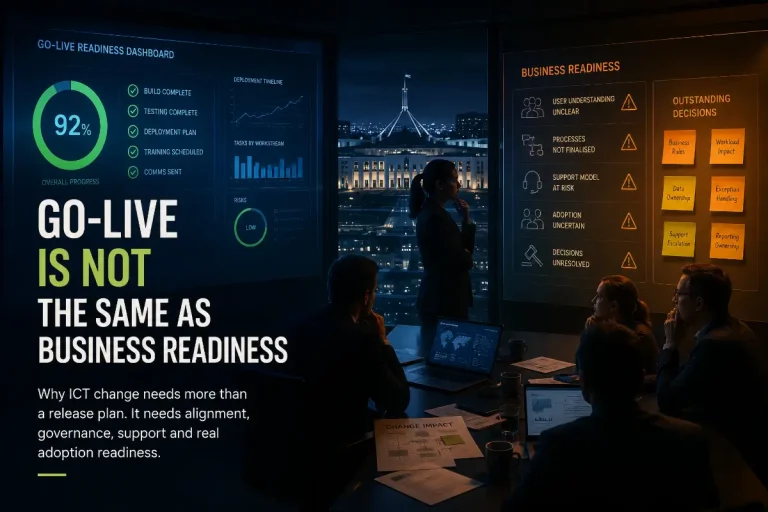
A system going live is not the same as the business being ready.
Most large ICT programs know this in theory, but the pressure of delivery has a way of narrowing everyone’s view. When the build is nearly done, testing is moving, and cut over planning is underway – the conversation moves from business readiness to whether the project can hit the date. This introduces program risk.
A system may be ready to release, but if the business is unclear about what is changing, how support will operate, and how we work differently; it turns quickly into confusion, increased support demands and poor adoption.
In public sector environments, ICT cuts across policy, operations, service delivery, vendors, executives, support teams and frontline users. Every one of these groups sees the change through their filtered lens, and each carries different levels of risk. A technically successful release can still land badly if the business has not been properly prepared and aligned before go live.
The system can be ready while the business is not
ICT projects naturally focus on the system. Environments need to be configured, integrations need to work, data needs to move, security requirements need to be met and vendors need to deliver. N
System readiness however, can’t be the only measure of success. While users still do not understand what it means for their work a feature can be available but the business hasn’t decided how or when to use it. A workflow can be technically configured but where it goes and who owns it can be unclear. A support model can exist on paper while users have no idea how to get help on day one.
That is how adoption risk appears: as duplicated work, spikes in support ticket volumes, inconsistent communication, confusion, and people drifting back to old ways of working.
By the time this becomes visible, the project is often in Hypercare and support teams are left carrying a raft of issues and angst that could have been cleared up before launch.
Readiness is a decision, not just communication
Change management isn’t just a comms task and that way of thinking doesn’t produce the right result.
Good change management tests whether a decision is ready to be communicated at all. If the business cannot answer the obvious follow-up questions, the message will just create noise. People do not only want to know that something is changing, instead they want to appreciate what the change means for their work, what processes are changing, who will support it and so on.
If the project cannot answer those questions, the message is not ready.
Communication should be disciplined. If you need to correct communication three times is not transparency – it is an exercise in trust erosion.
Governance should monitor adoption risk
Governance forums are usually comfortable with schedule, budget, scope and technical risk but can be less consistent at evaluating adoption risk. This should be a key concern because business readiness affects confidence in the outcome.
Unclear ownership is a governance issue, but so are unresolved business rules, stakeholder resistance, workload concentration, conflicting messages and decisions that no one owns.
Good change management surfaces these issues early enough for leaders to mitigate them, highlighting where the business is not ready, and what’s needed for change to land well.
Technical priorities need business translation
Technology teams can usually explain what a system does, but a technical explanation does not automatically translate into business meaning.
Business translation is not about simplifying technical language, it is about turning those technical decisions into what it means for the end-user. Such technical decisions can impact who does the work, how data is entered, who owns a task, what risk is being reduced and where support pressure will appear. It can shift workload, accountability, compliance exposure and the value the organisation expects to realise.
If those consequences haven’t surfaced, the change isn’t understood. Users see a new system, a new process, another training session, another instruction from somewhere above them they do not see themselves in the change.
Then project teams wonder why adoption isn’t happening.
Engagement is where the project finds out what it has missed
Stakeholder engagement is often treated as keeping people updated, but its real value is much more important – it helps the project find the problems early.
A good change network, super user group or business readiness forum will show where the message is unclear, where the process does not make sense, where leaders are uncomfortable, where support will be overloaded, and where users can already see trouble.
That feedback is not something to be ‘managed,’ it’s actually your second chance to fix something before it becomes too late.
Ignoring those feedback signals because they are inconvenient is poor delivery. Collecting the feedback and doing nothing with it is worse. Two-way communication only matters if it improves decisions, readiness or leadership action.
Support is where ignored readiness issues manifest
Go-live exposes readiness issues real fast.
When users do not know what to do, they ask someone. If that person does not know, the issue circulates. If you don’t have a good support model, the service desk becomes the dumping ground for every process question, training gap and unresolved decision.
That is how bottlenecks form – and a smooth implementation turns into operational firefighting.
Having a decent support model gives users a clear path to help. Self-service works when the answer is known. Local support helps where context matters. Formal ticketing is needed when the issue has to be logged and managed. Technical or vendor escalation should be reserved for problems that genuinely need deeper intervention.
This needs to be designed before go-live and explained before people need it. Otherwise, the organisation pays for poor readiness through support demand.
Proof of adoption is not optional
Training attendance is useful, but adoption evidence is required to ensure success.
An organisation needs better signals to know whether ICT change is landing. Login activity, completion of key day-one tasks, support themes, training questions, process errors, user confidence, leader reinforcement and whether people can find the right guidance without being rescued all tell a more useful story than attendance alone.
None of this needs to be elaborate. It needs to be purposeful and clear.
Adoption is not proved by telling people what changed. It is proved when people can work differently with enough confidence and consistency for the organisation to get value from the investment.
Go live is the start, not the finish
Of course go-live matters. It is a major milestone, but it’s not the finish line.
The real finish line is when the business understands the change, leaders can explain it, users can perform the work, support teams are not overwhelmed, risks are visible, and value is starting to come through.
That takes more than a release plan – it takes thorough attention throughout the development process.
It requires governance that surfaces the right risks, communication that waits until the message is ready, engagement that listens for what the project has missed, support models that can carry the first wave of demand, and adoption measures that show whether the change is actually being used.
ICT change lands when people know why it matters, what is changing, what they need to do differently, and where to go when they need help.
That is when technology starts delivering business value.